Jan 18, 2023
Insights from a large payer organization and Google Cloud

Summary
- Organizations must prioritize seamless and secure digital health consumer experiences (CX) to build trust and engagement.
- Platform-based healthcare CX solutions, rather than fragmented point tools, are essential for consistency and scale.
- Google Cloud’s secure data standards and interoperability supports more accessible and equitable care and optimizes the consumer side of healthcare.
- A large payer organization’s platform model exemplifies a platform-driven approach, placing consumers and clinicians at the center.
Healthcare executives across the country are pursuing aspirations of creating a more unified digital health ecosystem. But with a sea of point solutions built over the last decade causing inherent complexity, that process often results in initiatives without clear goals or metrics.
The urgency to address this situation is only growing more intense as projections signal that 36% of all the data created in 20251 will come from healthcare, according to Amy Waldron, global health plan solutions leader at Google Cloud.
Waldron spoke during a Health Evolution Connect Deep Dive session in Nashville that also included a senior healthcare executive and was led by League CEO and founder, Michael Serbinis.
During the discussion, the executives shared insights about unifying the consumer experience:
- Prioritizing the healthcare consumer experience (CX)
- Taking a platform approach
- Leveraging the power of personalization
Prioritizing consumer experiences
Healthcare organizations need to focus on creating consumer experiences that are inherently fluid and secure. Waldron emphasized that building and maintaining trust is a critical component to meeting consumer healthcare expectations.
In order for consumers to begin trusting a digital healthcare product with their personal data, they need to be built on a foundation that’s secure-by-design with leading-edge interoperability capabilities as well as provide a new level of transparency, consent management and value. Google Cloud achieves this by using Fast Healthcare Interoperability Resources (FHIR), best-in-industry data standards and solutions to optimize the consumer aspect of healthcare. Waldron also noted that it’s important for healthcare organizations to focus on creating seamless customer journeys across all touchpoints, from online appointment scheduling to in-person visits.
The payer’s platform approach focuses on bringing the healthcare consumer and clinician together. There is often a disconnect between the two parties when it comes to digital experiences. The payer has been addressing this challenge through its platform approach, which aims to place the customer and clinician at the center of healthcare via a secure, interoperable platform. The vision is to “improve health outcomes, reduce the cost of care, and ultimately make care more accessible.”
Taking a platform approach
Though a number of companies in the digital healthcare space use the term “platform,” Serbinis noted that very few of them have actually done the work to build a platform architecture. A key characteristic of a platform, according to Serbinis, is that it enables third-party developers to build upon it, creating a virtuous cycle of growth and innovation. He noted that this type of unified ecosystem creates more value for everyone involved, including healthcare consumers, who benefit from the added features and integrations.
“Partners like League provide a UI that creates a new experience for the user, turning the volume of data into value that’s relevant and actionable,” Google Cloud’s Waldron said.
For Google Cloud, a platform approach means taking the best aspects of technology and data management and applying them throughout the healthcare ecosystem. Waldron discussed how Google Cloud is approaching personalization in healthcare by leveraging data and technology resources to create more personalized experiences for each consumer while keeping health data secure.
Data and partnerships are key to personalization. Google Cloud is working with this payer organization and League to create experiences with the same level of specificity as other non-healthcare digital consumer experiences. This includes features like appointment reminders and educational content that use AI and machine learning to surface relevant content and insights.
Leveraging the power of platformization
Both Waldron and the senior healthcare executive emphasized the importance of personalized healthcare experiences. They agreed that in order for organizations to meaningfully drive engagement and trust, healthcare experiences need to be deeply personal. This means that the payer organization had to shift its digital approach from delivering healthcare to a more cohesive focus on whole-person health. Rather than engaging patients only during sporadic episodes of care, the healthcare platform model drives proactive engagement throughout their entire healthcare journey by connecting individuals to the resources that are the most relevant and impactful.
Waldron discussed how Google Cloud is approaching personalization in healthcare. She noted that the company is leveraging its vast data and technology resources to create a more personalized experience for each individual consumer while keeping health data secure. Data and partnerships are the keys to personalization, according to Waldron. She added that Google Cloud is working with payor organizations and League to create experiences that have the same level of uniqueness and specificity as other, non-healthcare digital consumer experiences.
She also noted that Google Cloud is leveraging these partnerships along with artificial intelligence and machine learning to personalize healthcare consumer experiences down to the individual level. By harnessing the power of currently available data, Google is able to provide more useful features and relevant content to consumers. This includes everything from appointment reminders to educational content and articles.
What’s next: using platforms to advance health equity
Serbinis wrapped the conversation by discussing the importance of health equity and the responsibility healthcare organizations have to ensure everyone has access to quality health experiences. He noted that platform technology could help bridge the gap between those with access to quality healthcare and those without.
All the leaders agreed that digital healthcare platforms will be critical in addressing material and systemic health inequities.
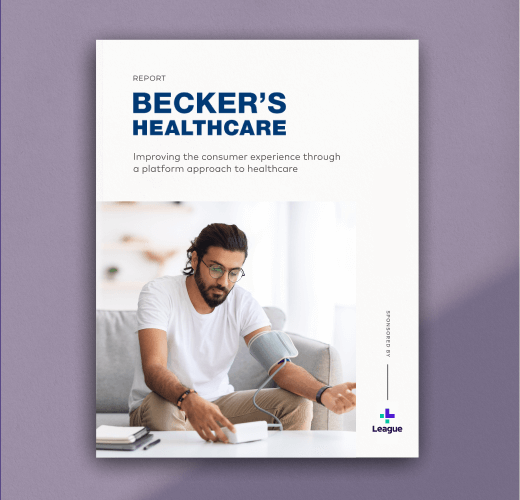
Becker’s Healthcare
Learn more about creating personalized consumer experiences in our report with Becker’s Healthcare.
1Source: RBC Capital Markets, The Healthcare Data Explosion https://www.rbccm.com/en/gib/healthcare/episode/the_healthcare_data_explosion